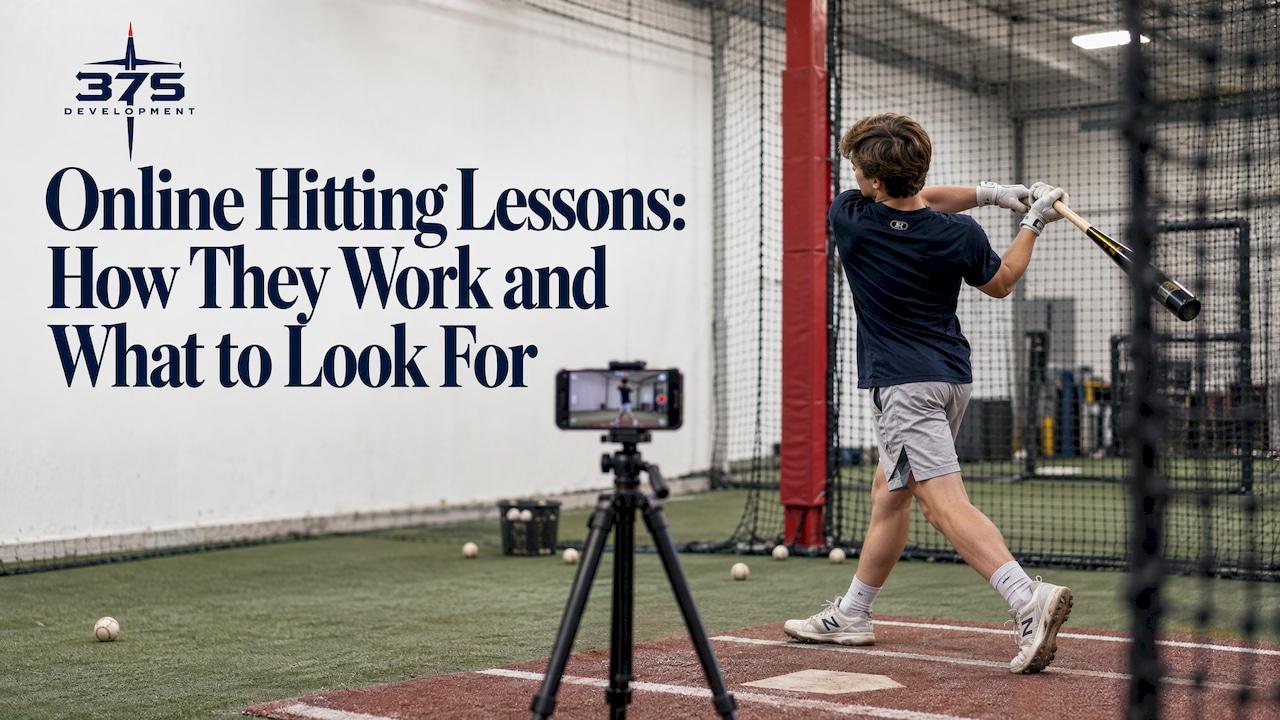
Online hitting lessons work when they give a hitter a diagnosis, a short list of priorities, and a plan to follow between check-ins. A pile of drill videos does none of that. The strongest remote instruction starts with an evaluation of your swing, turns it into specific practice, and reviews progress on a schedule. That is the structure behind 375 Development's Swing Evaluation, 8-Week Hitting Plan and Complete Hitter Program, and it is the standard to hold any online option to, whether you are a hitter, a parent, a coach or a facility owner.
TL;DR
- Online hitting instruction replaces the cage visit with filmed swings, written or recorded feedback, and a practice plan you carry out on your own.
- The lesson that matters is the one that tells you what to fix first and why. Generic drill libraries leave that part to you.
- Good footage needs a phone, a stable setup and two camera angles, not special equipment.
- A solid program has an evaluation, ranked priorities, drills, daily homework and scheduled progress reviews.
- Facilities and coaches can get the same structure as a curriculum plus instructor education, so every instructor teaches the swing the same way.
Table of Contents
- What online hitting lessons actually are
- What remote instruction does well
- How to film your swing so it can be coached
- What a structured online program should include
- Which skills travel well online
- Keeping remote practice purposeful
- How to choose between a one-time plan and ongoing coaching
- For coaches and facilities: consistency across instructors
- Where 375 Development fits
- FAQ
- Sources
What online hitting lessons actually are
An online hitting lesson moves the part of coaching that does not need you standing next to the hitter onto video and a shared plan. The hitter films swings, the instructor studies them, and the feedback comes back as a written evaluation, a call or annotated clips. The hitter then practices the assigned work and sends new footage for review.
This is different from watching free instructional videos. A video teaches a concept to everyone. A lesson looks at your swing, picks out what is limiting you, and tells you what to do about it this week. Searching for online baseball hitting lessons usually turns up both, so it helps to know which one you are buying.
It also differs from a single lesson. A swing changes slowly. One session can point out a flaw, but fixing it takes repetition and someone checking the result. That is why the format that works pairs an evaluation with a plan and follow-up, and why the plan matters as much as the diagnosis.

What remote instruction does well
Three things make online instruction a good fit for many hitters.
It slows the swing down. A swing is too fast for the naked eye to see what is happening, which is why slow-motion phone video became such a major step in youth hitting coaching. An instructor reviewing frames can see things that live viewing misses, and the hitter can see them too.
It reaches hitters far from a good instructor. Distance, travel time and cost put in-person coaching out of reach for many families. A remote evaluation gives a player in a small town the same quality of feedback as one near a major training center.
It leaves a record. Footage from March can be compared with footage from June. Hitters and parents stop guessing whether the swing has changed and can see it.
How to film your swing so it can be coached
Bad footage produces vague feedback. Most of the work is setup.
- Film in practice, not games. Use a tee or soft toss so the clip shows your best, most repeatable swing rather than a reaction to a live pitcher.
- Get the side view. Stand perpendicular to the batter's box, facing the hitter's chest. A filming guide for baseball swings notes this angle shows the stride, hip rotation, bat path and follow-through.
- Add the pitcher's view. That second angle shows hand position at contact. Two angles tell a much fuller story than one.
- Mount the phone at hip height. The same guide suggests roughly 10 to 15 feet away on an inexpensive tripod, so the frame stays steady and the full swing stays in it.
- Use slow-motion mode. The guide says 120 frames per second is enough for most reviews, and 240 captures finer detail such as bat flex at contact.
- Film the same way each time. Same angle, same distance, same drill. Consistency is what makes before-and-after comparisons meaningful.
The guide also lists flaws that commonly show up on video: stepping out of the swing path ("stepping in the bucket"), casting the hands, dropping the back shoulder, opening the front shoulder early and dragging the bat. Hitters can spot some of these alone, but spotting a flaw and knowing which one is causing the problem are different skills. That second skill is what a lesson provides.
What a structured online program should include
The questions to ask of any online hitting instruction are the same for a ten-year-old and a college recruit. Look for these five parts.
An evaluation that explains causes
A swing problem is usually a symptom. A late bat may come from a slow load, poor timing or a mechanical sequence issue. An evaluation should say what is happening and why, so the fix targets the cause rather than the symptom. 375 Development's approach centers on understanding the athlete and the causes behind performance, using metrics to support better decisions, movement and understanding of the swing. The Swing Evaluation is priced at $50 as a one-time purchase.
Ranked priorities
Hitters who try to fix six things at once fix none. A good program picks the one or two that matter most right now and sets the rest aside. This is where individualized instruction beats a general video library.
Drills tied to those priorities
Drills should have a reason. Tee work, soft toss and short toss each train different things, and the right choice depends on what the hitter is working on. Drills chosen from a list of favorites are a warning sign.
Daily homework
Progress happens between lessons, not during them. The plan should say what to do each day and how long it takes. The 8-Week Hitting Plan from 375 Development includes drills, practice priorities, progress reviews and daily homework, for $200 as a one-time purchase.
Progress reviews
Someone has to look at the result and adjust. Without reviews, a hitter can spend weeks rehearsing the wrong thing. Reviews also keep the plan honest: if a priority is fixed, the next one moves up.
Which skills travel well online
Mechanical work and practice design transfer easily to video: stride, load, hip and shoulder sequencing, bat path, and the drills that train them. Approach and decision-making can be taught remotely too, as long as the hitter tracks what happens in games and brings it back to the plan.
What changes with age is the content, not the format. Younger hitters, roughly ages 4 to 9, focus on tee work and soft toss with softly tossed pitches added over time. Situational hitting, such as hitting behind runners, shows up around ages 13 to 14, and count-based and two-strike approaches come in for older players, according to one youth coaching age guide. A good online program adjusts to the hitter's level and goals rather than handing every player the same routine.
Parents of younger players should expect shorter sessions and more repetition at the tee. Older hitters can handle more detail, data and self-evaluation.
Keeping remote practice purposeful
The common failure of online instruction is drift. The hitter watches the feedback once, practices for a week, then stops. Four habits prevent it.
- Write down what you worked on. A hitter journal turns practice into a record. 375 Development offers a Hitter Journal for this, and the idea is simple: note the focus, how it felt, and what changed.
- Set a weekly film day. One filmed session per week gives the review something to work with. The filming guide above suggests weekly filming during the season.
- Keep one priority at a time. When a priority is fixed, replace it. Do not add to it.
- Compare clips, not memories. Put this month's swing next to last month's. Feel is unreliable. Footage is not.
Parents can help most by handling the logistics: setting up the phone, keeping the film day on the calendar and asking what the priority is this week. They do not need to coach the swing.
How to choose between a one-time plan and ongoing coaching
The right choice depends on how much feedback a hitter needs.
| Need | Fit | Price |
|---|---|---|
| Find out what to work on | Swing Evaluation | $50 one-time |
| A defined block of work with drills and daily homework | 8-Week Hitting Plan | $200 one-time |
| Ongoing weekly development | Complete Hitter Program | $100 per week |
A hitter new to online instruction often starts with the evaluation, then moves to a plan once the priorities are clear. Hitters who want continuous guidance across a season or off-season fit the weekly program. All three are on the 375 Development hitters page.
For coaches and facilities: consistency across instructors
Online lessons expose a problem facilities already have. If three instructors teach three different swings, a hitter who works with all three gets mixed messages. That gets worse when remote feedback goes out under the facility's name.
The fix is a shared curriculum and instructors who are trained on it. 375 Development combines instructor education with a structured curriculum so a facility can teach hitting more consistently. Facilities can choose from three packages: Fine Tune at $750, Level Up at $1,200 and Full Implementation at $2,000, each a one-time purchase. Coaches who want to learn the system can also use 375 Development's coach education resources.
When every instructor evaluates, prioritizes and assigns drills with the same framework, online and in-person lessons line up. Hitters get the same message from every coach, and the facility can add remote programs without rewriting its teaching.

Where 375 Development fits
If you want online hitting instruction built on evaluation, individualized priorities and progress tracking, start with the Swing Evaluation, 8-Week Hitting Plan or Complete Hitter Program. Facilities that want a consistent teaching standard can look at the Fine Tune, Level Up and Full Implementation packages.

375 Development is also building HitScope, a video swing analysis tool, to help hitters track and analyze their progress. The goal across the whole system is purposeful development, both on and off the field.
FAQ
Can you really improve your swing with online hitting lessons?
Yes, when the lesson includes an evaluation of your own swing, clear priorities and a plan you follow between reviews. Improvement comes from repetition on the right things, and online instruction can direct that work as well as an in-person lesson can.
What equipment do I need for virtual hitting instruction?
A smartphone with slow-motion video, a tripod and a tee are enough to start. Film from the side and from the pitcher's view so the instructor can see the full swing.
How long does it take to see results?
Swings change gradually, so plan on weeks of focused practice rather than one session. That is why 375 Development's hitting plan runs eight weeks, with progress reviews and daily homework built in.
Are online hitting lessons right for young players?
They can be, with the content matched to age. Younger hitters focus on tee work and soft toss, and parents usually help with filming and keeping practice on schedule.